

On the evening of Tuesday March 10th, City Council will consider approval of Vancouver's first (interim) Official Development Plan. You can submit written comments or request to speak here. We recommend supporting the ODP — but Council needs to hear that this plan is just the first step and no where close to providing a successful, secure housing system for the city.
This ODP is a long nothing-burger just meant to fulfill the provincial requirement to have an ODP by June 2026. It is, intentionally, just a summary of existing policies in one plan. All of these policies have already been consulted on and debated at length.
The functional advantage of approving the plan is that Council will no longer need to hold public hearings for individual buildings, as long as they are consistent with the plan. This does not mean that any zoning is changing, just that rezonings will be decided on at regular council meetings instead of public hearings. Any proposal that is not consistent with the ODP will require an ODP amendment and trigger the need for a public hearing.
The Lack of Viable Zoning for Housing Need
According to the provincial requirements for calculating 20-year housing need, and close to the City's own previous estimates, Vancouver needs about 9,150 new homes per year, net of demolitions, to meet housing needs. Taking into consideration that Vancouver has not met this annual need with sufficient building permits in any year from 2021 to 2026, the average annual need over the next 15 years is significantly higher.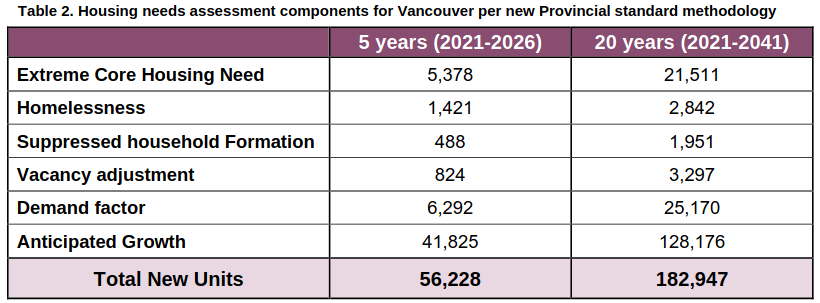
It is extremely obvious that this Official Development Plan will not accommodate meeting Vancouver's housing needs. On page 80 (PDF page 64) of the ODP, planners claim, without any enumeration, "when mapped across the city, the GLU [General Land Use] designations indicate enough capacity to exceed the City’s estimated 20-year housing need, as prescribed by the provincial government." This is very likely vacuously true in terms of "zoned capacity," e.g. if one assumes that every building in the city will be replaced in the next 20 years by the maximum allowed on its lot, even if that means adding one floor to an apartment building or demolishing 50,000 of single-family homes and duplexes to add one or two units as multiplexes. But those are not realistic assumptions at all about the next 15 or 20 years.
All we need to verify that this ODP will not address housing need over the next 15-20 years is look at the last 5 years. The City permitted on average only about 6,900 homes, and more like 6,100 homes net of demolitions. There have been recent changes that should help increase housing supply, such as the recent Rupert & Renfrew Station Area Plan. But this partly just offsets the opportunities in other areas that have already been redeveloped, and, according to the City's own economic testing, the apartments enabled by the plan are only marginally viable or not viable. It would be unreasonable to think that having fewer public hearings along with these and other recent changes will incentivize 50% more housing construction.
The truth is that our planners still simply do not consider addressing the housing shortage to be their highest priority. Time and time again, new policies fail to move the needle on construction and affordability because they are designed not to.