

The following is our letter to Vancouver City Council outlining our concerns and specific recommendations regarding the draft Rupert & Renfrew Station Area Plan as currently written. Council will consider approving it on Tuesday, July 8th.
Dear Mayor Sim and Council,
Abundant Housing Vancouver would like to offer our qualified support for the Rupert & Renfrew Station Area Plan. However, the plan needs significant improvements to be effective.
Overall, a lot of time and effort have gone into this plan over years, and the estimated 10,000 homes over 25 years from this plan represents a small contribution to addressing housing needs in Vancouver. The City’s latest housing needs report states that the city needs 56,228 additional homes in the five years to 2026, but completions are less than half of that, even before subtracting demolitions. The shortage in Vancouver is growing much faster than the 400 homes/year this plan is estimated to deliver. The planning regime needs to focus on delivering the highest opportunity policy changes first and delivering them faster, and that continues to not be apparent.
We have many specific concerns with the plan itself and the language in the plan is often somewhat ambiguous. The following is a summary of our most substantial concerns and recommendations to address them.
Unviable 6-storey Rental Requirements - Corner Lots
(from page 51 of the plan)
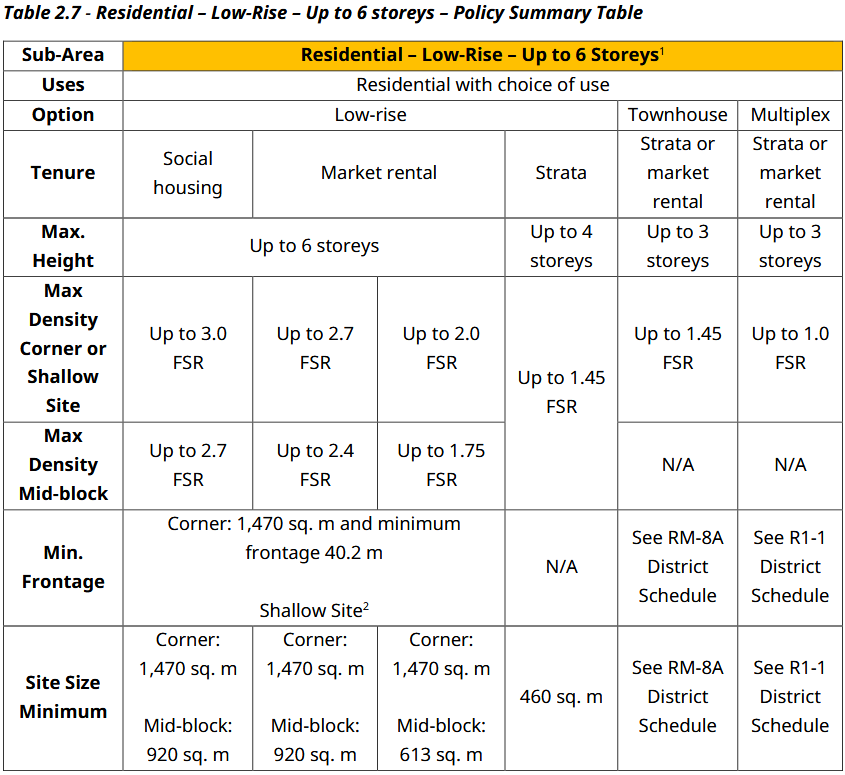
We are glad to see that 6-storey apartment buildings will eventually be allowed, on paper, on most of the residential land in the plan area, and that this does not come with inclusionary zoning requirements that have made such buildings unviable under previous policies. But, the remaining restrictions repeat some of the same mistakes that have made the Secured Rental Policy so ineffective. Zoning policies need to be economically viable at lower rents than we have today, otherwise they will not be able to improve affordability. The most glaring issue with the listed requirements is that corner lots are required to have a minimum of 1470 m2 area and 40.2m frontage (see page 51 of the plan), or four standard 33’x120’ lots. This will be very difficult to assemble; finding four willing sellers adjacent to each other is much more than 33% harder than finding three adjacent sellers. Imagine if 25% of homeowners are willing sellers and are distributed randomly, then the odds of any three adjacent lots all being sold are 16 in 1000, while the odds for four adjacent lots would be only 4 in 1000. Requiring all four of these to be standard lots with no allowance for any to be slightly smaller in any dimension makes it more difficult still. Four lot widths is more than the 99’ required for some 20 storey towers in the Broadway Plan. Furthermore, it appears from the policy table that assembling four standard lots is the only option for corner lots, even at lower density. Given that this is more than required by several recent policies, including the SRP, it is difficult to believe that this is not an intentional way to allow 6-storey apartments on quiet streets on paper but to make them very rare in practice, although it is possible some planners simply underestimate the difficulty of creating four-lot assemblies despite the dearth of three-lot assemblies in the secured rental policy areas today.
Recommendation: Council should reduce corner lot requirements to, at most, 15m frontage and 500 m2 area, with some reduction in achievable FSR to allow for setbacks on smaller lots.
Unviable 6-storey Rental & 4-Storey Strata Requirements & No Allowance for SES - Mid-Block
Similarly, we have already seen with the SRP that 1.75 FSR rental requiring lot assembly does not work. Removing the need for a spot rezoning will be a good first step, but it is still unlikely that this mid-block typology will be able to compete with multiplexes and existing uses. Strata development at 1.45 FSR requiring 460 m2 lots, depending on fees, will often not work either and will be mostly only applicable to existing 50’ lots. Council has shown admirable leadership in pushing to allow single-stair (SES) apartments in Vancouver’s building bylaw, but that will not matter much if there is no zoning for apartments on the typical 33’-wide lots in East Vancouver once SES is finally legalized. Given the cost, time and effort, city-initiated rezonings should be future-proofed for potential building bylaw changes, not needlessly restrictive. Finally, limiting strata development to 4-storeys in order to encourage 6-storey rental has the strong potential to result in less housing overall.
Recommendation: Reduce the lot size requirement to 300 m2 for the lowest density rental and strata typologies and explicitly allow the same on corner lots. Allow strata developments at the same height and density as rental buildings and use differences in fees to encourage or discourage strata as desired.Likewise, reduce lot sizes for the in-between densities so that they will be viable even if market rents fall substantially from what they are today.
Greatly Reduced Social Housing Density Allowance
The “Social Housing Initiative” proposal currently in the planning process excludes the Rupert & Renfrew plan area, and the R&R plan only allows social housing towers on the site of existing social housing. This is arbitrary and severely limits the applicability of the policy in the plan area. There is no particularly good reason that this area should be treated differently than other similar areas of the city that do not have a recent plan, nor that existing social housing sites should be the only places that new social housing should be constructed.
Recommendation: Council should amend the plan to be the same as the Social Housing Initiative, or include the plan area in the Social Housing Initiative policy.
Unviable 4-Storey Apartment Areas
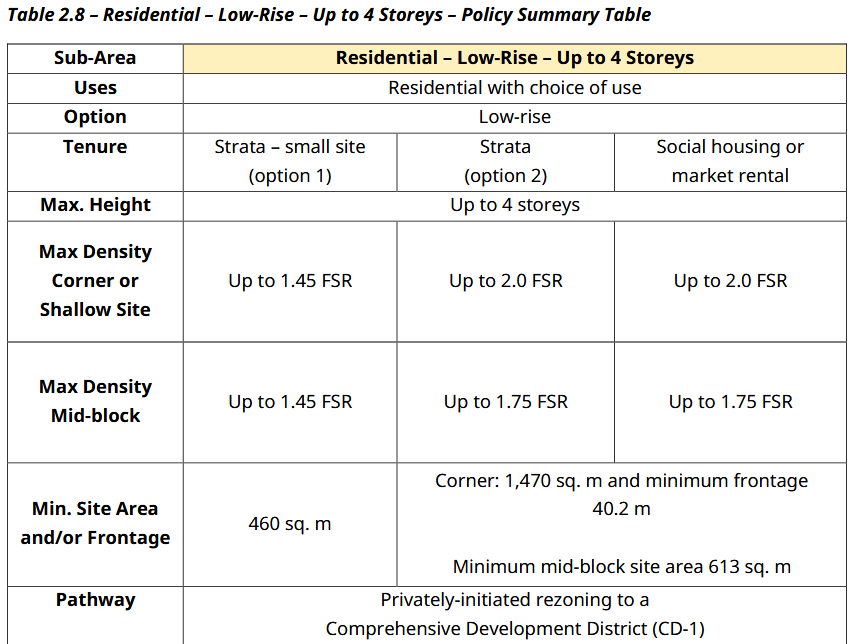
Proposals in 4-storey apartment areas require spot rezoning and lot assembly. This all but ensures that the vast majority of applications in these areas will be for duplexes, multiplexes, or single family dwellings. This directly contradicts Council’s expressed desire to locate more apartments near parks and schools.
Recommendation: Use broad city-initiated rezoning to enable 4-storey apartments in these areas. Reduce minimum lot size to 300 m2 (with the understanding that setback may decrease achievable FSR) to allow for single-lot development, with possible future SES legalization.
(from page 53 of the plan)
Multiplex Areas
There do not need to be any multiplex areas. Multiplexes can be built in low-rise apartment areas if they are desired. Multiplexes are not a significant means of addressing Vancouver’s housing needs. All of the areas currently designated for multiplexes are close enough to major thoroughfares, including rapid transit corridors like Hastings. Translink has proposed to add an express bus service along Renfrew connecting to the North Shore in the future.
Similarly, especially when it comes to zoning for 6-storey apartment buildings, the plan boundaries should be extended to the areas surrounding Hastings and Joyce Station. Every duplex that is built where the market would build an apartment building is an opportunity lost for a generation or more.
Recommendation: Convert all multiplex areas to 6-storey apartment areas. Expand the plan & 6-storey apartment area boundaries as much as possible North, South, and West.
Ambiguous “Protected Views”
It is not clear whether the protected views described in the plan are already achieved through the described zoning limits, or if they will create new “view cones” over the entire areas north of the origin lots, nor what the impact of these would be. Creating view cones “willy-nilly” without economic analysis of the potential impact, or even clear description of what they are, would be a serious mistake and display a profound lack of due diligence. Future tower development far from the origin points will generally not substantially “block” the mountain views, as the mountains are relatively tall and the view is generally of buildings with a mountain backdrop (or, in some cases, a view of urban sprawl up the North Shore mountains).
Recommendation: State clearly that the 4-storey areas in the plan constitute the complete implementation of the new protected views.
Conclusion
It does not make sense, for Council nor for City Hall more broadly, to spend the political capital on “allowing” 6-storey apartments throughout most of the neighbourhood while, in practice, keeping apartments mostly unviable, and on terms incapable of improving affordability. NIMBYs are much more afraid of hypothetical 6-storey apartments than real ones after they are built, and the vast majority of people who cannot afford a home in Vancouver today will not be satisfied with the impact of the multiplexes that are likely to result from this plan. We implore Council to make this plan count, by amending the plan to be much more effective at delivering housing for Vancouverites.